
The Show Goes On: Ten Years of hackaTUM
School |
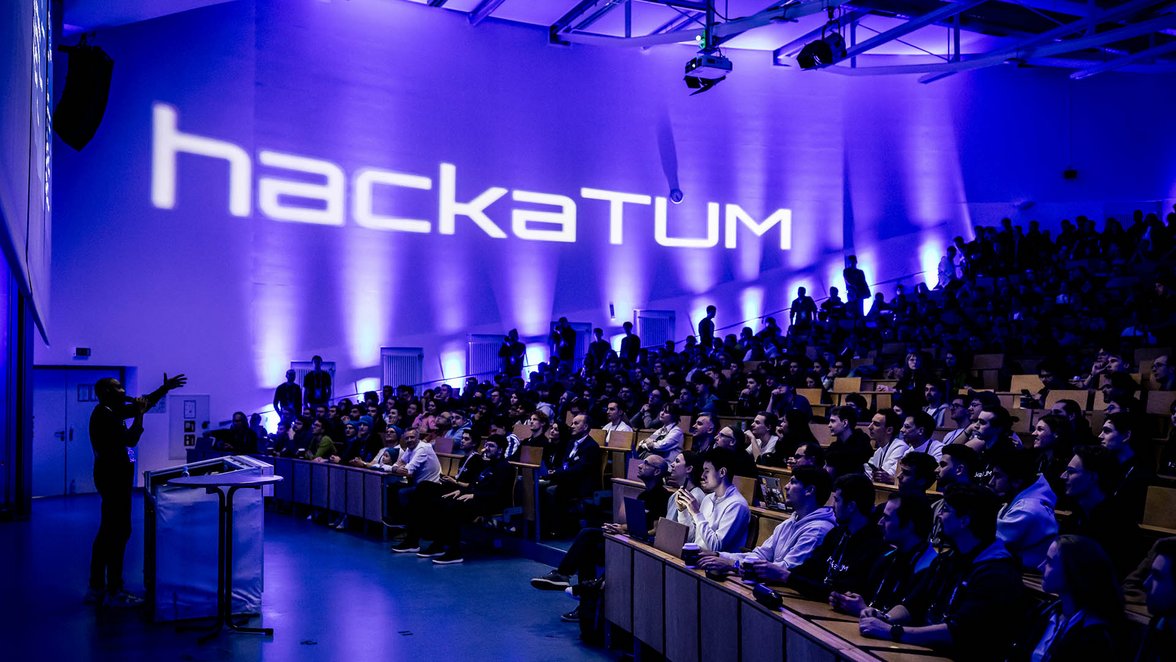
Atmosphere at the hackaTUM 2025, Photo: Bert Willer
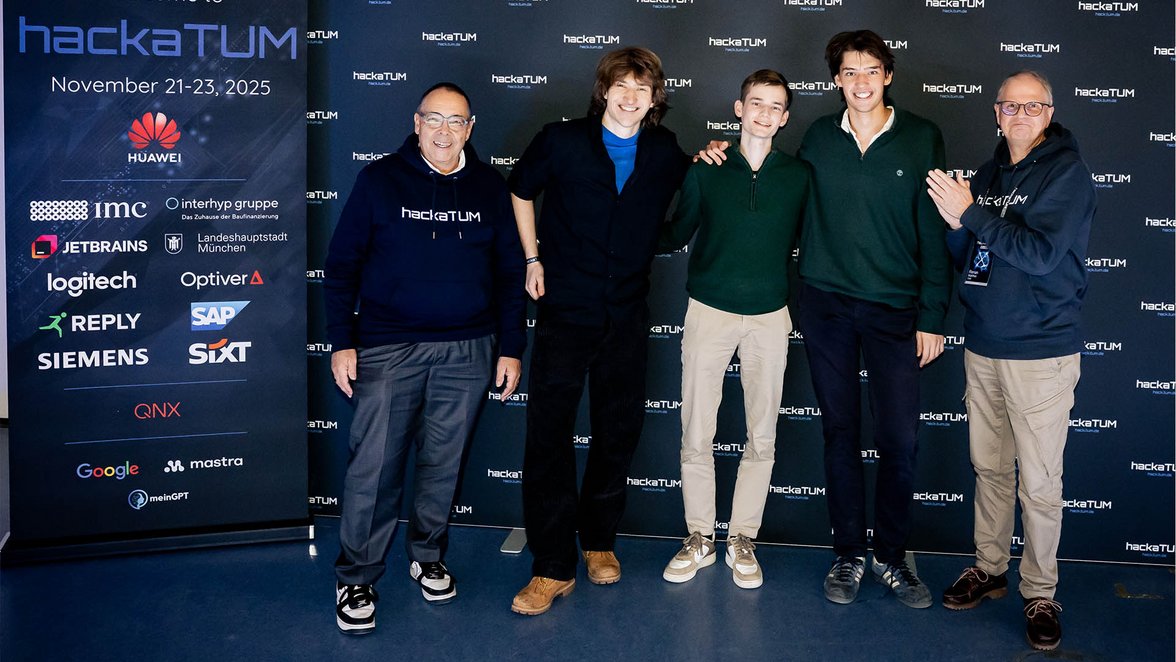
The winning team with the jury: Professor Emeritus Helmut Krcmar, Carl Ziesemer, David Holzwarth, Christoph Moritz Soppe und Professor Florian Matthes (from left). Not pictured: Lukas Ketzer. Photo: Bert Willer
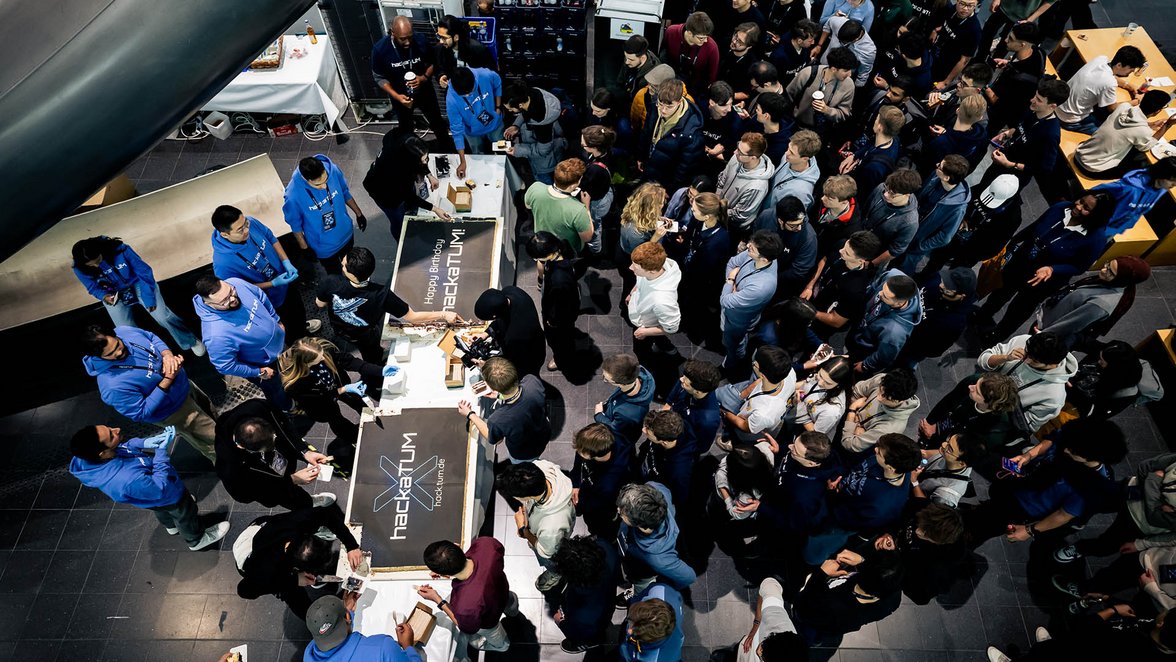
XXXL birthday cakes: 10 years of hackaTUM – delicious! Photo: Bert Willer
Originating from a research project, the programming competition has developed into one of the largest of its kind in Europe. Almost 2,000 applications were received for the tenth anniversary event. Over 80 percent of these came from TUM students. The remaining 20 percent came from students at 126 universities, high schoolers, and people from industry, since it is not necessary to be enrolled at TUM to take part in hackaTUM. 960 participants were selected. The 757 participants who made it to the finish ultimately submitted 247 projects.
Coding over the weekend
“Anyone who is enthusiastic about coding and can persevere for 36 hours can take part,” explains Stephen Meisenbacher with a smile. The doctoral student from the Chair of Software Engineering for Business Information Systems has been organizing the weekend event in his free time for several years now, together with his colleagues Alexandra Klymenko, Juraj Vladika, Franziska Tobisch, and Alexandre Mercier. 38 volunteers from TUM and beyond supported the team over the three days of the event. Eleven sponsoring companies provided twelve challenges this year, along with four additional sponsors.
“On Friday evening, the participants were introduced to the various tasks,” explains Alexandra Klymenko. “These are real problems from everyday life.” There was also a so-called “wild track” where participants could present their own tasks. In addition to the challenges, the companies offered workshops and were on-site to network. For the special tenth anniversary, DJ Dominik Koislmeyer created a great atmosphere on Friday evening, also fulfilling the audience's song requests. The specially made XXXL hackaTUM birthday cakes were particularly well received.
Concept, product, presentation
For the teams of two to four people there was not much sleep during the weekend. The aim was not just to develop a concept over the weekend. At the end, there had to be a finished product, for example, in the form of an app – including a convincing short presentation. The organizers provided the necessary food and plenty of energy drinks to keep the participants going.
On Saturday, a Music Mania quiz and Slideshow Karaoke ensured a great atmosphere and a further boost of motivation. As part of the annual hackaTUM swag handout and a special vintage swag edition, over 3,500 hoodies, shirts, and bags from recent years were distributed to happy owners. On Sunday, the results of the challenges were finally evaluated by the respective sponsor companies, and two winning teams were determined for each challenge.
Top 24 compete to choose the winning team
The best 24 groups from all tracks – with a first and second place each – competed to choose the overall winning team at the end. The jury, consisting of Florian Matthes, Professor of Software Engineering for Business Information Systems, and Professor Emeritus Helmut Krcmar, former Professor of Information Systems and founder of the KrcmarLab, decided in favor of the team „Vom Platzl“: David Holzwarth, Lukas Ketzer, Moritz Soppe, and Carl Ziesemer had chosen the challenge „Be a City Hero!“ from Landeshauptstadt München.
The focus was on developing a Google Chrome extension. The aim was to raise consumer awareness of the availability of goods in local stores. Many people have forgotten that the things they buy online are also available in their neighborhood. This is faster, more sustainable, and helps counteract vacancy rates in city centers.
“When we notice an intent of purchasing in a user's Google search query, the plugin takes action,” the four developers explain their solution. “We take over the Google Shopping overview and add an overlay. This presents local stores that sell the product the user is looking for, plus some details to help the user transition to visit the local store instead.” Instead of a new app that burdens the smartphone, the winners wanted to develop a product that could be easily integrated into everyday lives.
Code meets community: experience counts
The outstanding commitment of all the winning teams was rewarded with many attractive prizes, like high-quality electronics. Still, for many participants, the prizes are not the main focus. “hackaTUM is not just a programming competition, but also a great opportunity to have fun and make new friends with cool people who share the same enthusiasm,” says Stephen Meisenbacher. For him and his co-organizers, the enormous effort involved in preparing and running the hackathon was well worth it. “We are already looking forward to 2026,” reveal the doctoral students. “The unique hacker atmosphere, the innovative projects, and the feeling of creating something great motivate us every time.”
And there was hackaTUM: An Interview about the Early Days
Doctor Patrick Holl, former doctoral candidate at Prof. Florian Matthes's Chair of Software Engineering for Business Information Systems (sebis), is one of the first organizers of hackaTUM, the official hackathon of the TUM School of Computation, Information and Technology (CIT). The founder of the startup “Fusionbase,” a data hub for external data, fondly remembers his hackathon days.
How did you get the role of organizer, and what appealed to you most about organizing a hackathon?
Patrick Holl: hackaTUM was launched in 2016 by Anne Faber, a fellow doctoral student, and me. It was originally planned as a one-off event as part of an industrial research project. Since there was no informatics hackathon at TUM at the time, we thought: If we're going to do it, let's do it right. We wanted to lay the foundation for a long-term successful event. I was involved as an organizer until 2020 and then handed over the reins to Alexandra Klymenko, who was also a doctoral student at the sebis chair. She has done a great job since then and has further professionalized the event.
How did you find your first hackaTUM experience?
Patrick Holl: Chaotic. We jumped in the deep end in many ways, but in the end, an astonishing number of things worked out well. The feeling of having put together a successful event despite the somewhat chaotic organization was incredibly motivating.
What was your most important experience during your time at hackaTUM?
Patrick Holl: That you can learn anything, basically. Acquiring sponsors, organizing catering, creating schedules, designing posters and flyers, the entire branding process with logos, websites, and social media—none of this came naturally to us. We just jumped right in. With a motivated team that is eager to solve problems, almost anything is possible! That has shaped my view of new challenges in general.
What was the strangest thing that happened when you think back on hackaTUM?
Patrick Holl: We had several requests from overseas participants who wanted to come and asked for a refund on their plane tickets. Given our financial resources at the time, that was completely unrealistic, of course. During the event itself, a group once tried to smuggle beer crates out of the venue using handcarts. Stopping them was stressful, but looking back, it's an anecdote that makes you smile.
Would you have thought that hackaTUM would one day become one of the largest of its kind in Europe?
Patrick Holl: Yes. As an excellent university, TUM offers the perfect conditions: highly motivated students, committed professors, strong industry partners, and a very good infrastructure. When you consistently bring these building blocks together, it's only logical that such a format can grow strongly.
How did you manage that?
Patrick Holl: It was impressive to see how hackaTUM became more professional and bigger every year. It was an intense but very fulfilling time for the team. We all sacrificed a lot of our free time and approached the organization with a consistent problem-solving mindset. When something didn't work, the question was never “if” but always “how” we would solve it. In my opinion, this attitude is crucial in enabling the event to reach this level.
What can organizers take away from their experience with hackaTUM for the future?
Patrick Holl: You need to be genuinely passionate about the event. If you just see it as a “job”, it won't develop further and will eventually lose its magic.
In my opinion, hackaTUM still has a lot of potential for growth. To tap into this potential, you have to be willing to tackle obstacles and problems. At the same time, you gain a huge range of skills: from sponsorship and budget planning to event logistics and communication to branding, technology, crisis management, and team leadership. The learning curve is steep and very practical, which makes the commitment incredibly valuable in the long term.
What is your fondest memory of hackaTUM?
Patrick Holl: The team spirit. The extra miles that the organizing team and volunteers went to make the event possible. This shared sense of “we can do this” despite all the stressful moments is something that has stuck with me to this day.