
Changing Values: Ludwig-Prandtl-Straße becomes Anna-Boyksen-Straße
School |
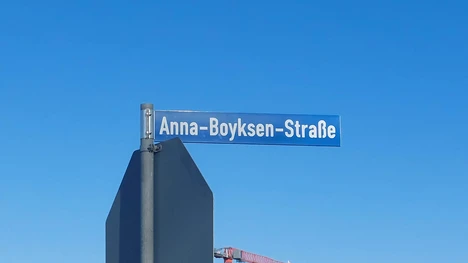
It was also in line with the wishes of the Technical University of Munich (TUM): On the Garching campus, all streets and rooms named after scientists with Nazi ties are to be renamed. As it is one of the most important scientific institutions in Germany, renaming Ludwig-Prandtl-Straße to Anna-Boyksen-Straße sends a strong signal.
Unknown Pioneer
Unlike Ludwig Prandtl, Anna Helene Boyksen (1881–1920) is relatively unknown. She was born on August 11, 1881, in Havendorfer Sand in the Grand Duchy of Oldenburg. Her father, a merchant, died when she was 11 years old. A guardian was appointed for her. Her secure financial situation and her talent enabled Anna Boyksen to attend the girls' high school in Karlsruhe, from which she graduated in 1904 with a university entrance qualification. She then studied mathematics and natural sciences at the University of Berlin for two years. In 1906, she became the first woman to enroll in a degree program in electrical engineering in Munich. This was remarkable because studying, especially at such an institution, was purely a male domain at the time.
Society allowed itself the luxury of neglecting the intellectual potential of half its population. Only in April 1905 had the Kingdom of Bavaria become the first German state to admit women to study at a technical university. The prerequisite for enrollment was a high school diploma from a German Gymnasium or Realgymnasium. This criterion proved to be a major hurdle at the time. Most interested women were unable to produce the required document due to a lack of support. In 1908, Anna Boyksen became the first woman to pass her intermediate diploma examination with a grade of “good.”
Controversial Figure
The now-departed namesake Ludwig Prandtl (1875–1953) is considered one of the most important fluid mechanics engineers of the 20th century. However, during the Nazi era, he was politically and institutionally controversial. He used the military significance of his research to obtain funding for a new wind tunnel. In 1942, he became chairman of the agency “Forschungsführung des Reichsluftfahrtministers und Oberbefehlshabers der Luftwaffe”.
Was he one of those researchers who cooperated with the Nazi system without supporting its ideology? Dr. Michael Eckert from the Forschungsinstitut für Technik- und Wissenschaftsgeschichte at Deutsches Museum in Munich answers this question in a nuanced way in his biography “Ludwig Prandtl – Strömungsforscher und Wissenschaftsmanager: Ein unverstellter Blick auf sein Leben” (Ludwig Prandtl – Flow Researcher and Science Manager: An Unvarnished Look at His Life). According to Eckert, Prandtl did not become a member of the NSDAP, but he did position himself “politically far to the right.”
A Sign of the Times
Even though Anna Boyksen's scientific achievements in the field of electrical engineering do not come close to those of Ludwig Prandtl, the renaming of the street is not only a sign of historical responsibility. It also symbolizes a change that is receiving special attention within TUM: the promotion of women and girls in the natural sciences as an important mission.