
Diese Seite ist nur auf Englisch verfügbar, da die Unterrichtssprache Englisch ist und wir für diesen Studiengang keinen Deutschnachweis fordern.
AI in Biomedicine – Elite Master's Program
Master of Science (M.Sc.)

Artificial Intelligence (AI) is rapidly transforming medicine, from diagnostics and drug discovery to personalized treatment and healthcare delivery. AI supports innovation in medicine and biotechnology, accelerates the development of new therapies and medical devices, and contributes to sustainable improvements in healthcare systems.
The Elite Master's Program AI in Biomedicine (AIBM) bridges the gap between computer science, engineering, and medicine to train future generations of AI experts who combine deep technical expertise in cutting-edge AI techniques with domain knowledge about biomedical applications. AIBM is a research-oriented two-year graduate program, with an optional Research Excellence Certificate, offered at the Technical University of Munich in cooperation with Friedrich-Alexander-Universität Erlangen-Nürnberg (FAU). It is designed to prepare students for careers in academic research and high-impact industrial innovation. The program emphasizes independent scientific thinking, methodological rigor, and the ability to contribute to the advancement of AI technologies in biomedicine.
The AIBM program’s technical themes span the full landscape of AI, machine learning, data science, and related topics, such as
- Trustworthy AI that is accepted and adopted by clinicians, patients and citizens;
- Human-Centered AI that enables personalization and effective collaboration between humans and AI to improve healthcare outcomes;
- and Multi-Modal and Generative AI that leverages emerging capabilities of AI systems to learn from complex data and generate new, meaningful samples.
Professional Profile: Data Science and Artificial Intelligence (PP DSAI)
Study Mode: Full-time
Language of Instruction: English
Duration of Studies: 4 Semesters
Credits: 120 ECTS + optional 30 ECTS for Research Excellence Certificate
Main Location: Garching
Program Start: Winter Semester
Costs: Semester Fees and Tuition Fees for Non-EU/EEA/Swiss
Information on scholarships and waivers for international students can be found here: Scholarships and Waivers
The AI in Biomedicine program is designed as a two-year full time Master's program (120 credits), with an optional Research Excellence Certificate (REC, additional 30 credits). Each academic year consists of two semesters.
The curriculum will be divided into four main topics: Foundations of AI courses offer knowledge about algorithmic and mathematical aspects of AI, while Applications of AI in Biomedicine and Healthcare courses introduce students to AI implementations in the medical and health sectors. Additionally, students will choose a Focus Subject to gain in-depth insights into foundations and/or applications of AI. Finally, the Cross-Cutting Themes topic enables students to gain skills in entrepreneurship & innovation, science communication, public and patient engagement. The curriculum is rounded off by the Master's thesis at TUM or FAU, or at one of our academic or industry partners.
Research Excellence Certificate (REC): Students can earn at least 30 credits in addition to the curriculum to graduate with the REC. For this, the students will select an additional Cross-Cutting Themes course, as well as a second focus subject with an additional elective course, an additional seminar and an additional research project. Students completing the additional REC (120 credits+ 30 credits) will be awarded a Master’s degree (M.Sc.) in AI in Biomedicine with the special grade "with Honours".
More details on the Degree Program Contents
Graduates of AIBM are trained to pursue careers in cutting-edge research in both academia and industry, as well as roles in startups, policy-making, and global health innovation, making AIBM graduates key contributors to shaping the future of healthcare and technology.
TUM supports students throughout their lives in terms of job search, career entry, and career development. For further details, refer to the TUM Career Service.
Upcoming: Online Walk-In Sessions for Application-Related Questions
For all those who still have questions about the AIBM program and application process, we offer online walk-in sessions on May 7th, May 21st and May 28th from 1:30 to 2:30 pm CEST.
Please join the session via the following link: https://bbb.cit.tum.de/rooms/y8a-xnk-56o-gmf/join.
Application
The selection process is based on an aptitude assessment, a two-stage process designed to evaluate the applicants' suitability for the specific requirements of the Master's program. Applicants are expected to have a sufficient background in areas such as mathematics, machine learning, and programming, and should hold or be on track to achieve one of the following qualifications or their equivalent:
- B.Sc. in Electrical and Computer Engineering
- B.Sc. in Computer Science
Application Timeline
- Submission Period: February 1 - May 31
- Interview Period: between May and September
- Interview Invitation Notification: at least a week's notice
Apply now
The application for admission to the master’s degree program in AI in Biomedicine is to be completed and submitted using TUMonline Applicant portal:
How to apply for a Master’s Degree Program – Step by Step
Only in the case of admission, some additional documents must be submitted as certified copies for enrollment.
Prospective students with a Bachelor's degree from outside Germany have to request preliminary examination documentation from uni-assist (VPD) in advance.
Each study program at TUM sets its own entry requirements to ensure students have the skills and knowledge to successfully complete it. The application requirements described below are specific to AIBM:
- Passport
- Curriculum Vitae (CV)
- Preliminary Documentation (VPD) issued by Uni-Assist (required for degrees from outside Germany)
- APS – Certificate of the Academic Evaluation Center (required for degrees from Chinese, Vietnamese or Indian universities)
- English Language Proficiency
- Transcript of Records and Module Catalog
- Curriculum analysis – Applicants should select the one below that applies to their degree and upload the generated PDF to their application in TUMonline:
→ For applicants with a background in Electrical and Computer Engineering (ECE)
→ For applicants with a background in Computer Science
Important Note for All Applicants: Only the credits specified on the transcript should be entered; any modules still in progress should not be included. Applicants studying or who have graduated from a related program that does not match one of the two curricular analyses above should choose the form that best aligns with their degree and upload only one in TUMonline. We encourage applicants to take time to carefully consider the selection, as the submitted analysis will be used during the admission evaluation. - Statement of Purpose
- Essay.
Further information on the required documents can be found in the Glossary of Documents.
Please carefully review the details provided in the International Applicant Guide.
Preliminary documentation from uni-assist (VPD)
Applicants with an undergraduate degree from outside Germany must apply for a preliminary documentation (VPD) from uni-assist, in addition to the TUM application. Since this can take up to four weeks, we recommend initiating the process early.
Certificate from the German Evaluation Center (Akademischen Prüfstelle, APS)
Applicants with an undergraduate degree from China, India, or Vietnam must submit a certificate from the German Evaluation Center (APS).
Grade conversion
The TUM Grade Conversion Formula gives an initial indication of the GPA. Note that this tool provides only an estimate.
Tuition fees for students from non-EU countries
At the Technical University of Munich (TUM), tuition fees are charged for international students from third countries who newly enroll in a degree program starting from the winter semester of 2024/25.
We strongly recommend that students from non-EU countries apply early, preferably before March 31, to allow enough time for visa processing and finding accommodation.
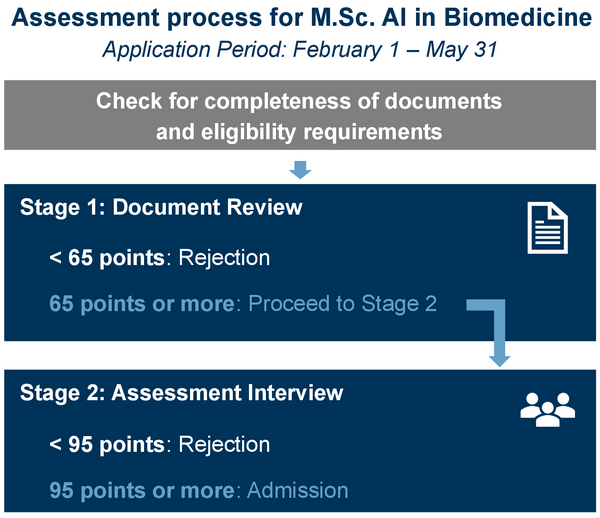
After the application is submitted, it will be checked for completeness by the central application department at TUM Center for Study and Teaching (CST). After that, it will be forwarded to the TUM School of Computation, Information and Technology (CIT), where the eligibility requirements are checked by assessing the subject-specific qualification:
- Subject-Specific Qualification (max. 35 points) in the field or a related field of Electrical and Computer Engineering or Informatics is evaluated based on the Curricular Analyses (see description in the “How Do I Apply” section). Applicants who score less than 18 points in subject-specific qualifications will be rejected.
All complete applications that score at least 18 points in subject-specific qualifications will be assessed by an Admissions Committee.
Stage 1: Document Review
Qualification Assessment Criteria in Stage 1:
- Subject-Specific Qualification (max. 35 points) in the field or a related field of Electrical and Computer Engineering or Informatics (see description above).
- Overall grade in Bachelor's Degree (max. 30 points)
- Statement of Purpose (max. 20 points)
- Essay (max. 15 points)
Applicants will receive a notification of the Stage 1 result: rejection (less than 65 points) or interview invitation (65 points or more).
Stage 2: Assessment Interview
Only applicants who received 65 points or more in Stage 1 will be invited for admissions interviews. Applicants will be notified of the interview date at least a week in advance. The interview typically lasts 20-30 minutes and is conducted as a video conference. Further details regarding the interview will be sent directly to the invited candidates.
Qualification Assessment Criteria in Stage 2:
- Subject-Specific Qualification (max. 35 points) in the field or a related field of Electrical and Computer Engineering or Informatics.
- Overall grade in Bachelor's Degree (max. 30 points)
- Assessment interview (max. 65 points)
Applicants will receive a notification of the Stage 2 result: rejection (less than 95 points) or admission (95 points or more).
This FAQ provides answers to frequently asked questions. We are happy to answer all remaining questions.
- Is there a specific deadline for international applicants?
No, there is no fixed deadline for international applicants. However, based on our experience, we strongly recommend submitting your application as early as possible to ensure sufficient time for the visa process. The final deadline for applications (EU as well as non-EU Applicants) is end of May. - I want to apply, but I cannot find the program in the application portal.
The program is only shown in TUMonline during the application period (February-May). Select “Master of Science” for the intended degree and “AI in Biomedicine” will be in the drop-down of degree programs. - Which B.Sc. degrees are accepted?
Applicants should have a solid foundation in areas such as mathematics, machine learning, and programming. Typically, candidates hold — or are on track to complete — one of the following degrees or an equivalent qualification:
- B.Sc. in Electrical and Computer Engineering
- B.Sc. in Computer Science
Please review the curricular analyses listed under “Which Documents Do I Need to Submit With My Application?” and include the one that best matches your academic background.
No degree is automatically accepted or excluded based solely on its title. Each application is assessed individually, and eligibility depends on the specific courses and content covered during your studies. Eligibility can therefore only be assessed on the basis of an official and complete application. - Is prior knowledge or experience in biomedicine required?
No, prior experience in biomedicine is not required. However, familiarity with the field can be helpful. If relevant, you may highlight any biomedical experience or motivation in your statement of purpose. - Is there a minimum number of credits required on my transcript at the time of application?
Yes. At the time of application, you must have completed at least 140 ECTS. - Which courses count in the curricular analysis?
Only courses certified by an accredited university and documented in an official transcript can be considered in the curricular analysis. - How is the curricular analysis assessed?
You can receive a maximum of 35 points in the curricular analysis. If you are missing credits in comparison to the listed TUM modules, those TUM credits will be subtracted in points from the maximum score of 35. The detailed criteria are defined in the Program‑Specific Academic and Examination Regulations. - Curricular analysis: Is it possible to list one course under several TUM modules or categories?
Yes. If one of your courses covers topics relevant to multiple TUM modules, you may list it for multiple modules and add a percentage in brackets to indicate how much of that course approximately matches the module you are listing it for. The admission committee will then review the module catalog and count the credits accordingly. - Is it possible to include courses that will be completed after the application deadline in the curricular analysis?
No, only completed courses that are listed in your transcript can be listed in the curricular analysis. - Is an “Abitur” or an English Bachelor’s thesis accepted as proof of English language proficiency?
No. An “Abitur” certificate or an English‑language Bachelor’s thesis alone are not recognized as proof of English proficiency. You can find all accepted language certificates and detailed requirements here. Please direct questions about formalities to studium@tum.de. - Can I use a VPD that I previously obtained or do I have to apply for a new VPD?
You may reuse a previously issued VPD if you applied for your VPD with a fully completed degree and nothing about your academic records has changed since then. In this case, the document remains valid for up to three years from its date of issue. However, if your academic records have changed, you will need to apply for a new VPD.
During Your Studies
The Elite Master's Program AI in Biomedicine is designed as a 2-year full-time program that requires students to complete 120 credits to obtain the academic degree Master of Science. Optionally, a Research Excellence Certificate can be obtained, which requires additional 30 credits. Below, you will find information on how to navigate the academic requirements.
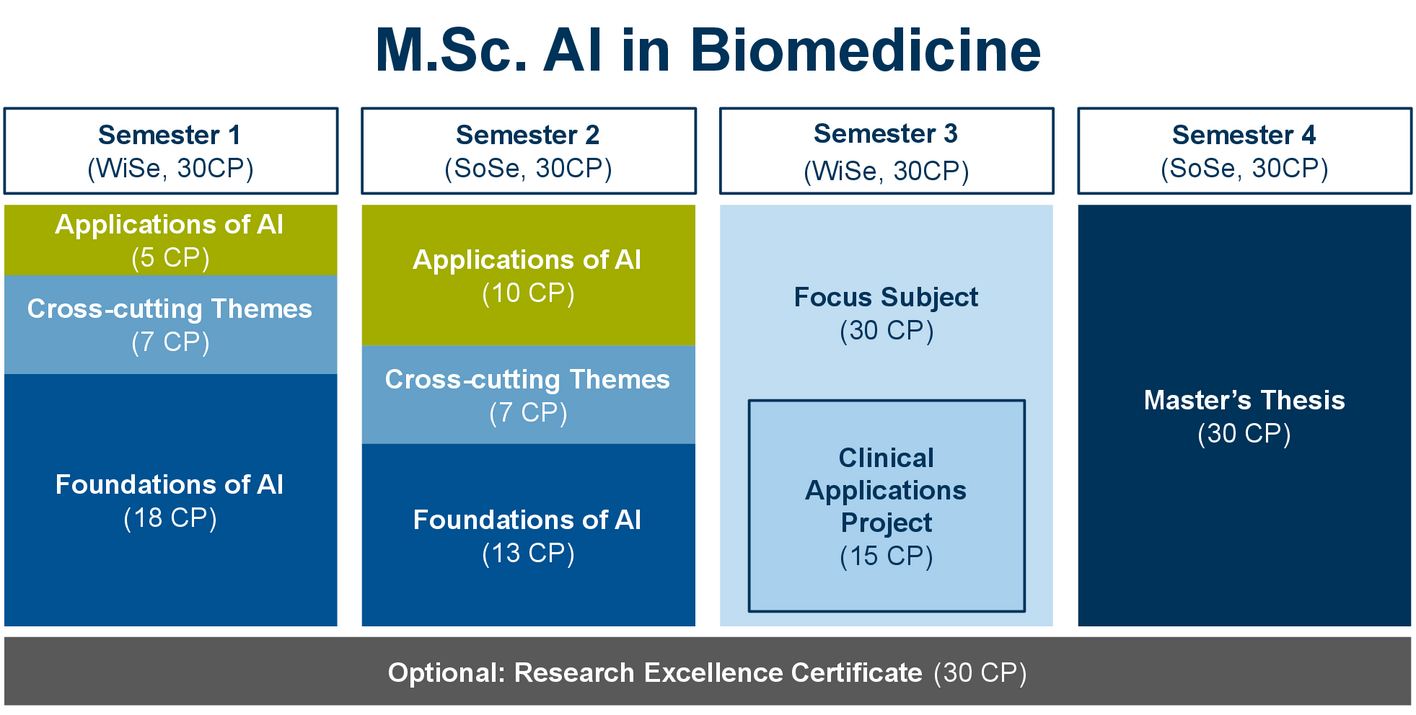
The AIBM curriculum includes a total of 8 mandatory courses (41 credits) in the areas of Foundations of AI and Cross-cutting Themes:
| Foundations of AI: | |||
| CIT423005 | Foundations of AI in Biomedicine | WiSe | 8 Credits |
| CIT423007 | Trustworthy AI for Medicine | WiSe | 5 Credits |
| CIT423009 | Multi-modal AI in Medicine | WiSe | 5 Credits |
| CIT423006 | Advanced AI in Biomedicine | SoSe | 8 Credits |
| CIT422001 | Human-Centered AI | SoSe | 5 Credits |
| Cross-cutting Themes: | |||
| SOT53506 | AI, Biomedicine and Society: Exploring the Social and Political Dimensions of AI in Biomedicine | WiSe | 3 Credits |
| CIT422000 | Research Skills and Methods | WiSe | 4 Credits |
| SOT53507 | Ethics of AI | SoSe | 3 Credits |
The focus subject allows students to specialize in one of four domains:
- Advanced Machine Learning
- Drug Discovery and Computational Biology
- Imaging and Sensing
- Natural Language Processing and Speech
Each focus subject combines theoretical foundations acquired through specialized elective courses with hands-on, research-oriented training provided in the Master’s seminar and in a clinical applications project. An individual study plan is compiled for each student in close collaboration with the student's personal mentor (more information under “AIBM Mentoring”).
Clinical applications project in Cardiology/Neurology/Oncology
The students work on advanced clinical application projects in the area of the chosen focus subject under realistic conditions, often in collaboration with clinical or industrial partners.
| CIT000001 | Clinical applications in Cardiology/Neurology/Oncology | WiSe/SoSe | 15 Credits |
Master's seminar
TUM and FAU offer a wide range of seminars, allowing students to choose from a broad spectrum of topics. Students must earn 5 credits from the following list.
| IN2107 | Master Seminar | WiSe/SoSe | 5 Credits |
| EI77009 | Seminar Machine Learning | WiSe/SoSe | 5 Credits |
Different topics are offered for the modules in this list every semester. The seminar should be chosen within the area of the focus subject.
Specialized elective courses
Students must earn at least 10 credits in their focus subject from this module list. The catalogue of elective courses is continuously updated by the examination board.
Modules from FAU can also be recognized, e.g. Deep Learning, Advanced Deep Learning, Pattern Recognition, Flat Panel CT, or Pattern Analysis. The examination board decides on the recognition.
Regardless of the chosen focus subject, students must earn 15 credits from elective modules in the area of Applications in Biomedicine and Healthcare and additional 4 credits in the area of Cross-cutting Themes:
| Applications in Biomedicine and Healthcare: | |||
| CIT423008 | Computer-Assisted Interventions & Therapy | WiSe | 5 Credits |
| MH4L74213 | Medical Data Science | WiSe | 5 Credits |
| MH4L74211 | Computational Biology and Pathology | SoSe | 5 Credits |
| MH4L74212 | Computer-Assisted Diagnosis | SoSe | 5 Credits |
| Cross-cutting Themes: | |||
| IN9011 | Project Management | WiSe | 4 Credits |
| CIT422003 | Entrepreneurship & Innovation in Medicine and Healthcare | SoSe | 4 Credits |
| CIT422002 | Medical Device and AI Regulation | SoSe | 4 Credits |
As part of the six-month Master’s Thesis (30 credits), students are required to independently address a specific and complex research question within the field of AI in Biomedicine, applying the specialized knowledge and methodological skills acquired during their studies.
The Master's Thesis module typically serves as the final examination, consisting of two components: a scientific report (graded) and a presentation (ungraded). Students may be allowed to begin the thesis earlier if they have successfully completed the clinical applications project. The total duration, including the submission of the thesis, must not exceed six months from the start date.
The Master’s Thesis can be supervised by one of the participating chairs at TUM or FAU. Collaboration with external research institutions or industry partners, both domestic and international, is also possible and highly encouraged.
Available theses at the TUM School of Computation, Information and Technology are published here.
Very ambitious students can earn at least 30 credits in addition to the AIBM curriculum to graduate with the research excellence certificate (Prädikat “with Honours”). For this, the students choose a second focus subject. Students need to:
- earn additional 6 credits from specialized elective courses in the area of the second focus subject
- finish a clinical applications project in cardiology/neurology/oncology in the area of the second focus subject
- earn additional 5 credits from a Master's seminar in the area of the second focus subject
- earn additional 4 credits from the cross-cutting themes area.
If the clinical applications project in the area of the first focus subject has already been completed at TUM or FAU, the additional one should preferably be completed either with one of the industrial or academic partners.
Graduation
Once the students have fulfilled the necessary requirements and submitted their thesis, they graduate with the Master of Science (M.Sc.) degree, opening the door to their professional career. For guidance on graduation and future steps, check out Graduation for helpful tips and advice.
AIBM Associated Faculty & People
TUM - School of Computation, Information and Technology
- Prof. Dr. Zeynep Akata, Interpretable and Reliable Machine Learning
- Dr. Martin Menten, Artificial Intelligence in Healthcare and Medicine
- Prof. Dr. Nassir Navab, Computer Aided Medical Procedures
- Prof. Dr. Daniel Rückert, Artificial Intelligence in Healthcare and Medicine
- Prof. Dr. Julia A. Schnabel, Computational Imaging and AI in Medicine
- Prof. Dr. Dr. Fabian Theis, Mathematical Modelling of Biological Systems
TUM - Other Schools
- Prof. Dr. Martin Boeker, Medical Informatics (TUM School of Medicine and Health)
- Prof. Dr. Ruth Müller, Science & Technology Policy (TUM School of Social Sciences and Technology)
- Prof. Dr. Daniel Roth, Machine Intelligence in Orthopedics (TUM School of Medicine and Health)
- Prof. Dr. Peter Schüffler, Computational Pathology (TUM School of Medicine and Health & TUM School of Computation, Information and Technology)
- Prof. Dr. Björn Schuller, Health Informatics (TUM School of Medicine and Health & TUM School of Computation, Information and Technology)
- Prof. Dr. Christian Wachinger, Artificial Intelligence in Radiology (TUM School of Medicine and Health)
- Prof. Dr. med. Dominik Pförringer, TUM Venture Lab Healthcare
Friedrich-Alexander-Universität Erlangen-Nürnberg (FAU)
- Prof. Dr. med. Thomas Ganslandt, Medical Informatics, Biometry and Epidemiology (FAU Faculty of Medicine)
- Prof. Dr. Bernhard Kainz, Image Data Exploration and Analysis (FAU Faculty of Engineering)
- Prof. Dr. Andreas Maier, Pattern Recognition (FAU Faculty of Engineering)
- Prof. Dr. Vincent C. Müller, Theory and Ethics of Artificial Intelligence (FAU Faculty of Philosophy)
- Dr. Paula Andrea Pérez-Toro, Pattern Recognition (FAU Faculty of Engineering)
As of April 2026
AI in Biomedicine offers a 1:1 mentoring and coaching system, which pairs each student with a personal mentor. This allows the students to discuss electives of their curriculum, get feedback on their progress, and also discuss career choices. Furthermore, the students will be mentored in the development of essential professional skills, including entrepreneurship, innovation management, and science communication.
In addition, AIBM-associated faculty and visiting guests help students build their very first professional network and learn about career options and role models.
Being part of the AI in Biomedicine Elite Master's Program also offers great opportunities for the students' careers and professional network. As a member of the Elite Network of Bavaria, students will, for instance, receive exclusive invitations to seminars, workshops and events. The ENB Community enables them to connect with other elite students and initiate joint activities. We expect from our AIBM students to participate in this peer group and to contribute to this unique institution for outstanding talents.
AIBM students have the opportunity to engage in projects with leading national and international academic partners and host these distinguished experts for guest lectures. Our network includes established collaborations with the following researchers:
- Prof. Albert Chung (Hong Kong University of Science and Technology, China)
- Prof. Ben Glocker (Imperial College London, UK)
- Prof. Bernd Wollscheid (Eidgenössische Technische Hochschule (ETH) Zürich, Switzerland)
- Prof. Daniel Alexander (University College London, UK)
- Prof. Dacheng Tao (Nanyang Technological University, Singapore)
- Prof. Ender Konokoglu (Eidgenössische Technische Hochschule (ETH) Zürich, Switzerland)
- Dr. Enzo Ferrante (CONICET / Universidad de Buenos Aires, Argentina)
- Prof. Fancesco Ciompi (Radboud UMC, Netherlands)
- Prof. Hrvoje Bogunović (Medical University Vienna, Austria)
- Prof. Inti Zlobec (Inselspital / Uni Bern, Switzerland)
- Prof. Jana Hutter (Leibniz Universität Hannover, Germany)
- Prof. Josien P.W. Pluim (Eindhoven University of Technology, Netherlands)
- Prof. Juan Eugenio Iglesias (Harvard Medical School / Massachusetts General Hospital, USA)
- Prof. Kensaku Mori (PoNagoya University)
- Prof. Lisa Koch (University of Bern, Switzerland)
- Prof. Maria Zuluaga (EURECOM, France)
- Prof. Mathias Unberath (Johns Hopkins University, USA)
- Prof. Mert Sabuncu (Cornell University, USA)
- Dr. Meritxell Bach Cuadra (Université de Lausanne, Switzerland)
- Prof. Michael Bronstein (University of Oxford, UK)
- Prof. Nicholas Ayache (INRIA, France)
- Dr. Oliver Colliot (Paris Brain Institute, France)
- Prof. Oscar Camara (Universitat Pompeu Fabra, Spain)
- Prof. Qi Dou (The Chinese University of Hong Kong, China)
- Prof. Rasmus R. Paulsen (Technical University of Denmark, Denmark)
- Prof. Riccardo Lattanzi (NYU Grossman School of Medicine, USA)
- Prof. Sergios Gatidis (Stanford University, USA)
- Prof. Sotirios Tsaftaris (University of Edinburgh, UK)
- Prof. Thomas Yeo (National University of Singapore, Singapore)
As of April 2026
AIBM bridges the gap between academic research and industrial innovation. Students have the opportunity to tackle real-world challenges through hands-on projects with leading industry partners.
- Amazon (Munich, Germany)
- BioM Biotech Cluster Development (Munich, Germany)
- Brainlab (Munich, Germany)
- Carl Zeiss (Oberkochen, Germany)
- Chimaera (Erlangen, Germany)
- DeepC (Munich, Germany)
- Google (Munich, Germany)
- Heidelberg Engineering (Heidelberg, Germany)
- IBM Deutschland (Munich, Germany)
- ImFusion (Munich, Germany)
- Johnson & Johnson (Munich, Germany)
- Medical Valley EMN e. V. (Erlangen, Germany)
- Mint Medical (Heidelberg, Germany)
- MIRA Vision Microscopy (Wangen, Germany)
- NVIDIA (Munich, Germany)
- Orbem (Munich, Germany)
- Philips Healthcare (Hamburg, Germany)
- Siemens Healthineers (Erlangen, Germany)
- Snke OS (Munich, Germany)
- TUM Venture Labs (Munich, Germany)
- UnternehmerTUM (Munich, Germany)
As of April 2026